
Fortinet FortiSandbox Authentication Bypass (CVE-2026-39813): Seven Months After the Patch, Scanners Are Checking
CVE-2026-39813 is a CVSS 9.8 authentication bypass in Fortinet FortiSandbox 4.4.0 to 4.4.8 and 5.0.0 to 5.0.5. One crafted request reads the appliance’s version, serial number, and encrypted configuration backup without a password. CrowdSec has observed 24 IP addresses sending matching requests since November 18. Upgrade to 4.4.9 or 5.0.6.
CVE-2026-39813 at a glance
| Affected | FortiSandbox 4.4.0 through 4.4.8 and 5.0.0 through 5.0.5. FortiSandbox 5.2 is not affected. The advisory does not mention FortiSandbox Cloud or PaaS. |
| Fixed in | 4.4.9 and 5.0.6 (FG-IR-26-112, April 14, 2026) |
| Vulnerability class | Path traversal in the JRPC API’s session check, leading to authentication bypass (CWE-24) |
| Severity | CVSS 3.1: 9.8 Critical (Fortinet base score). The Live Exploit Tracker and several sources show 9.1, Fortinet’s temporal score. |
| Authentication required | None |
| Public exploit | The request has been public since imjdl’s patch analysis of April 21, 2026. A Nuclei template, merged November 12, 2026, uses it to read the system status. |
| CISA KEV | Not listed as of the November 20, 2026 catalog. Two other FortiSandbox flaws, CVE-2026-39808 and CVE-2026-25089, were added on July 16, 2026. |
| CrowdSec detection rule live since | November 13, 2026 (“Rule Released” on the tracker) |
| First exploitation attempt observed | November 18, 2026, on the Live Exploit Tracker. Defused and KEVIntel reported attacks on June 15, 2026; requests sent before the CrowdSec rule existed are not counted. |
| Exploitation phase | Limited Exploitation (Live Exploit Tracker) |
| Observation window used here | Signals from November 18 to 22, 2026 (5 days); tracker addresses to November 23; CTI data over the 30 days to November 23. |
Key findings
- Seven months between the fix and our first sighting: Fortinet patched CVE-2026-39813 on April 14, and the working request was published on April 21. Defused and KEVIntel reported attacks on June 15. The Nuclei check followed on November 12, the CrowdSec rule on November 13, and the first matching request on November 18.
- Low volume, familiar senders: 42 signals from November 18 to 22, peaking at 23 on Friday, November 20. The 23 addresses CTI links to CVE-2026-39813 match a median of 191 CVEs each. Nine also match the Cisco ISE bypass CVE-2026-76460, and eight the FortiWeb bypass CVE-2025-64446.
- One upgrade, three flaws: FortiSandbox 4.4.9 fixes CVE-2026-39813 and the two command injections CISA added to KEV in July; 5.0.6 fixes it and CVE-2026-25089. Every release CVE-2026-39813 affects is open to at least one of them, and the bypass reads out the exact version.
What is Fortinet FortiSandbox, and who is exposed to CVE-2026-39813?
FortiSandbox is Fortinet’s malware analysis appliance. Firewalls, mail gateways, and endpoint agents send it suspicious files and links; it runs them in isolated virtual machines and returns a verdict. Security and SOC teams run it, usually in larger organizations already built on Fortinet. Any FortiSandbox on 4.4.0–4.4.8 or 5.0.0–5.0.5 whose web interface an attacker can reach is exposed. Fortinet’s hardening guide keeps that interface on a management network, so an internet-facing FortiSandbox is a configuration mistake on the customer’s side, and it is the kind scanners find.
Why CVE-2026-39813 matters: On its own, CVE-2026-39813 gives an outsider the appliance’s identity and configuration, not control. It also tells them which firmware is running, and every affected release is open to at least one command injection that CISA lists as exploited.
How does CVE-2026-39813 work?
FortiSandbox’s JRPC API, at /jsonrpc/ and /fortisandbox/jsonrpc/, checks a login by looking for a file named after the session ID in its session folder. The is_valid_session() function joins the client’s session value to that folder path without checking it. A session of ../../tmp/ points at /tmp/, a folder that always exists and was modified recently, so the check passes. The root cause in one sentence: the appliance treated “this path exists” as “this user logged in”.
According to imjdl, the forged session can read the system status (version, hostname, serial number), scan settings, and the configuration backup, which is encrypted with a key stored on the appliance. Write operations still fail. Fortinet rates the impact as “escalation of privilege”; no public source we found shows CVE-2026-39813 alone writing a file or running a command. The fix accepts only 32-character hexadecimal session IDs.
- Found internally by Loic Pantano of Fortinet PSIRT. Patch analysis by imjdl (April 21, 2026). Nuclei check by ritikchaddha: template
- Vendor advisory: FG-IR-26-112 · Fix: FortiSandbox 4.4.9 and 5.0.6 (closed source, no public commit)
Fortinet published CVE-2026-39813 on April 14 together with CVE-2026-39808 (FG-IR-26-100), an unauthenticated command injection through an API endpoint. A third flaw, CVE-2026-25089 (FG-IR-26-141), followed on June 9. Honeypots run by exploit intelligence company Defused then recorded attempts to exploit all three. KEVIntel saw CVE-2026-39808 exploited on June 12, and both Defused and KEVIntel reported attacks on CVE-2026-39813 on June 15, SecurityWeek reported. CISA added the two command injections to KEV on July 16. As of November 23, CVE-2026-39813 is not in KEV, and Fortinet’s advisory still reads “Known Exploited: No”.
What is the CrowdSec Network observing for CVE-2026-39813?
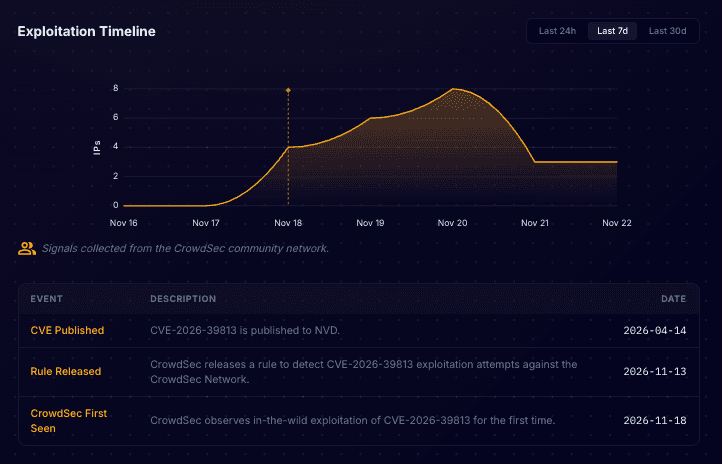
Between November 18 and 22, 2026, the CrowdSec Network recorded 42 signals from machines reporting requests that match the CVE-2026-39813 exploitation pattern, detected by the CrowdSec rule released on November 13. That averages 8.4 per day, peaking at 23 from 8 unique IP addresses on Friday, November 20. The Live Exploit Tracker lists 24 unique IP addresses through November 23 and rates CVE-2026-39813 at Limited Exploitation.
By day: 4, 9, 23, then 3 on each weekend day. The requests are the public check, almost word for word: a POST to /fortisandbox/jsonrpc/ or /jsonrpc/ with the session ../../tmp/, asking for sys/status. That reads the version and serial number and stops. Whoever sends it is taking inventory.
The senders fit that reading. 15 of the 23 addresses CTI links to CVE-2026-39813 over the 30 days to November 23 are Amazon, 11 of them in Ireland, consistent with rented infrastructure rather than a residential botnet. 40% of signals came from Ireland and 31% from the US. Each address matches a median of 191 CVEs, and the most focused still matches 28; none is a FortiSandbox specialist. Addresses rated malicious sent 7 of the 42 signals; the Friday peak came entirely from addresses rated “known”. Targets follow where CrowdSec is deployed: 33% of signals hit machines in France, 26% in the US, 12% in the UK.
The part worth flagging is what else these addresses check. Nine of the 23 also match the Cisco ISE bypass CVE-2026-76460, eight the FortiWeb bypass CVE-2025-64446, and six CVE-2026-39808, FortiSandbox’s own KEV-listed command injection. CVE-2026-39813 has joined the lists that sweep security appliances. Its sibling shows where that leads: CVE-2026-39808 has drawn 333 unique IP addresses on the tracker since June 17, against 24 here. A read-only flaw is easy to push down the list, but on FortiSandbox the read sorts patched boxes from open ones. The low numbers are a head start, not a reason to wait.
These are exploitation attempts against machines in the CrowdSec Network, a sample rather than a census, and CrowdSec cannot confirm any succeeded. Requests sent before November 13, when the rule did not exist, are not counted.
How do you protect Fortinet FortiSandbox against CVE-2026-39813?
Patch. Upgrade FortiSandbox to 4.4.9 or later, or 5.0.6 or later (FG-IR-26-112).
Preemptive blocking. Subscribe to the CrowdSec Intelligence Blocklists and enforce them on the firewall in front of FortiSandbox. 12 of the 23 addresses CTI links to CVE-2026-39813 over the 30 days to November 23 (52%) are on at least one CrowdSec blocklist, including all six rated malicious. That removes the known sweepers. It does not cover most of the Amazon addresses, or an address the network has never seen.
Stay proactive. Follow CVE-2026-39813 on the Live Exploit Tracker and query its sources in CrowdSec CTI.
Frequently asked questions about CVE-2026-39813
Is CVE-2026-39813 being exploited in the wild? CrowdSec observes exploitation attempts. The CrowdSec Network recorded 42 signals matching the CVE-2026-39813 pattern between November 18 and 22, 2026, and the Live Exploit Tracker lists 24 unique IP addresses through November 23. Defused and KEVIntel reported attacks on June 15. Fortinet has not confirmed exploitation, CISA has not added it to KEV, and CrowdSec cannot confirm any attempt succeeded.
Which versions of Fortinet FortiSandbox are affected by CVE-2026-39813? FortiSandbox 4.4.0 through 4.4.8 and 5.0.0 through 5.0.5. The first fixed releases are 4.4.9 and 5.0.6. FortiSandbox 5.2 is not affected.
Can CVE-2026-39813 alone give an attacker control of FortiSandbox? No public source we found shows it. It reads system details and an encrypted configuration backup; write operations fail. The risk is what it reveals: FortiSandbox 4.4.8 or earlier is also open to CVE-2026-39808 and CVE-2026-25089, and 5.0.5 or earlier to CVE-2026-25089, both in CISA KEV.
Related CrowdSec threat alerts
- Week 27 — CVE-2026-39808, FortiSandbox command injection
- Week 45 — CVE-2026-76460, Cisco ISE authentication bypass
- Week 47 — CVE-2025-64446, FortiWeb authentication bypass
Written by Matthieu Mazzolini, Data Team Lead, CrowdSec. Published November 23, 2026.