
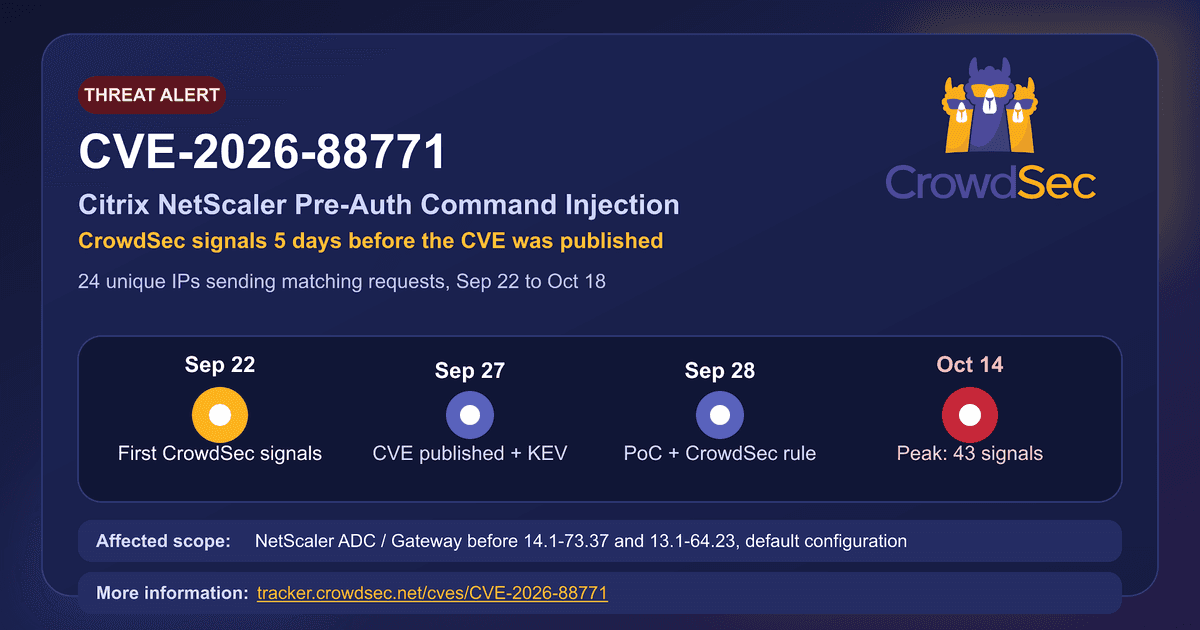
CVE-2026-88771 is a CVSS 9.5 unauthenticated command injection in Citrix NetScaler ADC and NetScaler Gateway, default configuration included. CrowdSec recorded matching requests on September 22, 2026, five days before Citrix published the CVE and its fix, and has tracked 24 unique IP addresses since. Check for compromise, then upgrade to 14.1-73.37 or 13.1-64.23.
You can track the CVE here.
CVE-2026-88771 at a glance
| Affected | NetScaler ADC and NetScaler Gateway 14.1 before 14.1-73.37 and 13.1 before 13.1-64.23; NetScaler ADC 14.1-FIPS before 14.1-73.37 FIPS; NetScaler ADC 13.1-FIPS and 13.1-NDcPP before 13.1-37.279. The default configuration is vulnerable; no extra feature needs to be enabled. |
| Fixed in | 14.1-73.37, 13.1-64.23, 14.1-73.37 FIPS, 13.1-37.279 FIPS and NDcPP (Citrix bulletin CTX697096, September 27, 2026) |
| Vulnerability class | Improper input validation that lets attacker-written text written to a log run as a shell command (CWE-20) |
| Severity | CVSS 4.0: 9.5 Critical |
| Authentication required | None |
| Public exploit | Yes. watchTowr’s Detection Artefact Generator, published September 28, runs a harmless id command as root to prove the flaw. |
| CISA KEV | Added September 27, 2026, with a remediation deadline of September 30 for US federal agencies |
| CrowdSec detection rule live since | September 28, 2026 |
| First exploitation attempt observed | September 22, 2026 by CrowdSec, five days before the CVE was published. Beazley Security dates a likely campaign to September 20; researcher Kevin Beaumont reports webshells since early September (Beazley Security). |
| Exploitation phase | Insufficient Data (Live Exploit Tracker, October 19, 2026) |
| Observation window used here | Signals from September 28 to October 18, 2026 (21 days). Unique IP addresses from September 22 to October 18, per the Live Exploit Tracker. Source profile: the 17 addresses CrowdSec CTI links to the CVE over the 30 days to October 19. |
Key findings
- Signals five days before the CVE was published: CrowdSec’s tracker recorded requests matching the CVE-2026-88771 pattern from one IP address on September 22, one on September 23, and two on September 26. Citrix published the CVE and its fix on Sunday, September 27, already confirming attacks, and CISA gave federal agencies three days. Any NetScaler exposed in September may have been compromised before a fix existed.
- A trickle on the CrowdSec Network: 308 signals between September 28 and October 18, about 15 a day, peaking at 43 on October 14. watchTowr counted thousands of attempts on its own honeypot sensors. The gap is targeting, not safety.
- One Russian address sent most of the hostile traffic: Of 127 signals from addresses CrowdSec CTI rates malicious, 107 came from a single address on the Prospero OOO network between October 10 and 15. Another 117 signals came from watchTowr’s own research scanners.
- Upgrading does not evict anyone: watchTowr’s post-exploitation analysis found implants, a backdoored SSH server, a rogue superuser account, and webshells hidden in the login page folder. A new firmware build removes none of them.
What is Citrix NetScaler, and who is exposed to CVE-2026-88771?
NetScaler ADC and NetScaler Gateway are the appliances that let employees, contractors, and partners reach internal applications from outside: VPN, Citrix virtual desktops, single sign-on, load balancing. Network and infrastructure teams run them, and they face the internet by design. That is their job.
Why CVE-2026-88771 matters: It gives an attacker root on the box that every remote session passes through. From there, they can read the appliance’s configuration, including the service accounts it uses to check passwords against the company directory, and sit on the path to internal systems. In the cases watchTowr analysed, attackers copied the configuration folder and created their own superuser.
The CrowdSec data says little about who is being targeted. The Live Exploit Tracker has no sector profile for CVE-2026-88771 yet, and a third of the signals came from Australian machines that watchTowr’s scanners visit nearly every day.
How does CVE-2026-88771 work?
An attacker sends a login request to /nf/auth/doAuthentication.do with a crafted username. NetScaler writes that username to its logs. A maintenance script, ns_monuploadd_err.pl, later reads those log lines and pastes part of them into a shell command without checking what they contain. Shell characters in the username then run as root. The script runs on a schedule, so the command can fire up to 24 hours after the request. The root cause in one sentence: a script treated its own log file as trusted input. Any logged field an attacker controls, such as the User-Agent header, can carry the payload.
Reported by Sina Kheirkhah, watchTowr Labs: write-up (September 28, 2026) · post-exploitation analysis (October 7, 2026)
Vendor advisory: Citrix CTX697096 · Compromise assessment: Citrix CTX694799
CVE-2026-88771 shipped in an eight-CVE bulletin. Its sibling CVE-2026-88772, a CVSS 9.5 memory overflow that needs DTLS (on by default for Gateway VPN servers), was also exploited and is fixed in the same builds. CVE-2026-88771 is the sixth serious NetScaler flaw reachable without a login since mid-2023, after CVE-2023-3519, CitrixBleed (CVE-2023-4966), CitrixBleed 2 (CVE-2025-5777), CVE-2026-3055 from Week 14, and CVE-2026-8451 in June.
What is the CrowdSec Network observing for CVE-2026-88771?
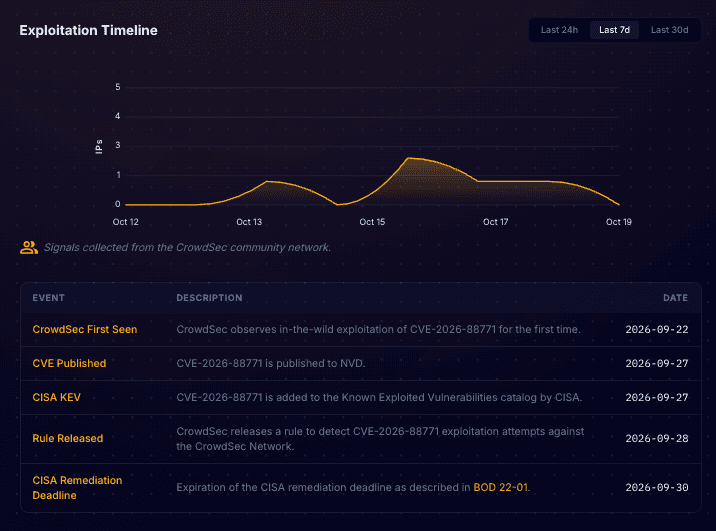
Between September 28 and October 18, 2026, the CrowdSec Network recorded 308 signals from machines reporting requests that match the CVE-2026-88771 exploitation pattern, detected by the CrowdSec scenario released on September 28, 2026. That averages 14.7 signals per day, between one and seven source addresses a day, peaking at 43 signals on Wednesday, October 14. The Live Exploit Tracker lists 24 unique IP addresses from September 22 to October 18.
The activity did not start with the advisory. The Live Exploit Tracker shows requests matching the CVE-2026-88771 pattern from one IP address on September 22, one on September 23, and two on September 26, all before Citrix published the CVE on September 27. That fits Beazley Security’s September 20 campaign date. The signal totals above start on September 28, so they do not include these early requests.
CrowdSec CTI links 17 addresses to CVE-2026-88771 over the 30 days to October 19. They fall into three groups:
- watchTowr’s research fleet: ten Amazon addresses in Singapore, classified as a known security company. They sent 117 signals (38%), a steady few nearly every day since the rule went live. This is watchTowr checking exposure for its customers, not an attack.
- One Russian address on Prospero OOO: 107 signals between October 10 and 15, which made last week the busiest so far (148 signals against 85 the week before). CTI links it to 22 CVEs, and it is already on the CrowdSec Intelligence Blocklist. An opportunistic exploiter is adding NetScaler to its list.
- Six others: two more rated malicious (hosting providers in the UAE and Switzerland), one suspicious OVH address in Canada, and three rated only “known”. Two of those three matched CVE-2026-88771 and nothing else: an Amazon address in the US and a Dutch residential address that only hit Polish machines, from October 4 to 6.
The part worth flagging is that last pair. Single-purpose, low-noise addresses are what a careful operator looks like, and they are the last thing a reputation list catches.
What this data does not show
- A matching request is an exploitation attempt. CrowdSec cannot confirm any succeeded, and cannot see the command firing up to a day later.
- Most machines in the CrowdSec Network are web servers, not NetScaler appliances. Attackers who check for a NetScaler first never reach them, so these counts understate the campaign.
- 24 unique IP addresses are not 24 threat actors: ten belong to one research company.
- The September 22 to 26 requests were linked to CVE-2026-88771 once CrowdSec’s rule shipped on September 28. They show activity before publication, not its full extent, and they count in the tracker’s 24 addresses, not in the 308 signals.
- The tracker (24 addresses, September 22 to October 18) and CTI (17 addresses, 30 days) count over different windows, so the totals differ.
What defenders get wrong about CVE-2026-88771
The first mistake is treating the upgrade as the finish line. CVE-2026-88771 was exploited before Citrix’s fix: CrowdSec saw matching requests five days before publication, and others report activity weeks earlier. Patching after a zero-day is changing the lock with someone possibly already inside. Worse, the upgrade’s reboot wipes running implants from memory, along with the evidence. The order matters: snapshot the appliance, hunt, then patch. If you find anything, rebuild from a clean image and rotate every credential the appliance stored.
The second is reading our low numbers as low risk. The tracker says “Insufficient Data” because our sensors are not NetScalers, and serious operators pick their targets before they send anything. For comparison, CitrixBleed 2 (CVE-2025-5777) has drawn 544 unique addresses on the tracker since July 2025. Loud, sprayed exploitation arrives once tools spread. The quiet phase is the dangerous one.
The third is the virtual patching reflex. NetScaler is the front door; in most networks, nothing sits in front of it to inspect requests. The trade-off is real: imaging a VPN gateway means remote staff lose access for a while. Schedule the window, but do not skip the evidence step to shorten it.
How do you protect Citrix NetScaler against CVE-2026-88771?
- Patch. Upgrade NetScaler ADC and Gateway to 14.1-73.37 or 13.1-64.23 or later (FIPS: 14.1-73.37 FIPS; FIPS and NDcPP: 13.1-37.279) per CTX697096. The same builds fix CVE-2026-88772. Before you do, follow Citrix’s CTX694799 and check for watchTowr’s documented traces: unknown superusers in
/flash/nsconfig/ns.conf(such asgw_health), files in/var/tmp, /var/vpn/ns_helper, hidden files under/var/netscaler/logon/LogonPoint/, a listener on TCP port 37512, and unknown keys in/root/.ssh/. Confirm the fix with show ns version on the NetScaler command line. - Virtual patching with CrowdSec open source WAF (AppSec). Not the right tool here. As of October 19, 2026, the CrowdSec Hub has no virtual-patching rule for CVE-2026-88771, and the AppSec Component can only inspect requests that pass through a web server or reverse proxy you control before reaching NetScaler. Most deployments have none.
- Preemptive blocking. Subscribe to the CrowdSec Intelligence Blocklists and enforce them on the firewall in front of NetScaler. Two of the three malicious addresses above, including the Prospero OOO address, are already on the CrowdSec Intelligence Blocklist. It does not cover the single-purpose addresses rated only “known”, or any address the network has never seen. The Public Internet Scanners blocklist covers part of the watchTowr fleet if you would rather not be catalogued.
- Stay proactive. Follow CVE-2026-88771 on the Live Exploit Tracker and query its sources in CrowdSec CTI.
Unsure where to start? Begin with our 3-minute introduction track here.
Frequently asked questions about CVE-2026-88771
Is CVE-2026-88771 being exploited in the wild?
Yes. CrowdSec recorded matching requests from September 22, 2026, five days before the CVE was published. Citrix confirmed exploitation in its September 27 bulletin, and CISA added it to KEV the same day. The CrowdSec Network recorded 308 matching signals between September 28 and October 18, at low volume.
Which versions of Citrix NetScaler are affected by CVE-2026-88771?
NetScaler ADC and Gateway 14.1 before 14.1-73.37 and 13.1 before 13.1-64.23, plus FIPS builds before 14.1-73.37 FIPS and FIPS and NDcPP builds before 13.1-37.279. The default configuration is affected.
Can I mitigate CVE-2026-88771 without upgrading?
Not reliably. The flaw sits in the default configuration, so there is no feature to switch off. Restricting who can reach the login page and blocking known malicious addresses reduce exposure, and neither removes an attacker already on the appliance.
Related CrowdSec threat alerts
- Week 14 — CVE-2026-3055, Citrix NetScaler SAML memory overread
- Week 39 — CVE-2025-4427, Ivanti EPMM authentication bypass
- Week 51 — CVE-2025-59718, Fortinet SAML authentication bypass
Written by Matthieu M., Data Team Lead, CrowdSec. Threat data reviewed by Thibault Koechlin, CTO, published October 19, 2026.