
Check Point Management Server Takeover (CVE-2026-93616): Attacked in July, Patched in September, Now Mapped Every Weekday
CVE-2026-93616 is a CVSS 9.8 flaw that lets an outsider take over a Check Point Security Management Server, the system that sets policy for every Check Point firewall. Check Point saw attacks on July 23rd, two months before its fix. CrowdSec has observed 956 unique IP addresses sending matching requests since October 21. Patch, then check for compromise.
CVE-2026-93616 at a glance
| Affected | Check Point Security Management Server, Multi-Domain Security Management Server, Log Server, Multi-Domain Log Server and SmartEvent: R82.20 without the fix, R82.10 Jumbo Hotfix Take 44 or lower, R82 Take 126 or lower, R81.20 Take 166 or lower, R81.10 Take 190 or lower, and end-of-support R80.x and R81. Firewall appliances and Spark are not affected (sk1000171). |
| Fixed in | R82.20 Security Hotfix or Jumbo Take 10, R82.10 Take 45, R82 Take 127, R81.20 Take 170, R81.10 Take 192 (Check Point, September 22, 2026). No fix for R80.x and R81. |
| Vulnerability class | Path traversal and file upload in the management web service on TCP port 19009 (CWE-22) |
| Severity | CVSS 3.1: 9.8 Critical (Check Point) |
| Authentication required | None |
| Public exploit | No exploit code as of November 16. Bishop Fox documented the attack and released an external patch check on October 1; a Nuclei detection template followed on October 14. |
| CISA KEV | Added September 22, 2026, with a September 25 deadline for US federal agencies |
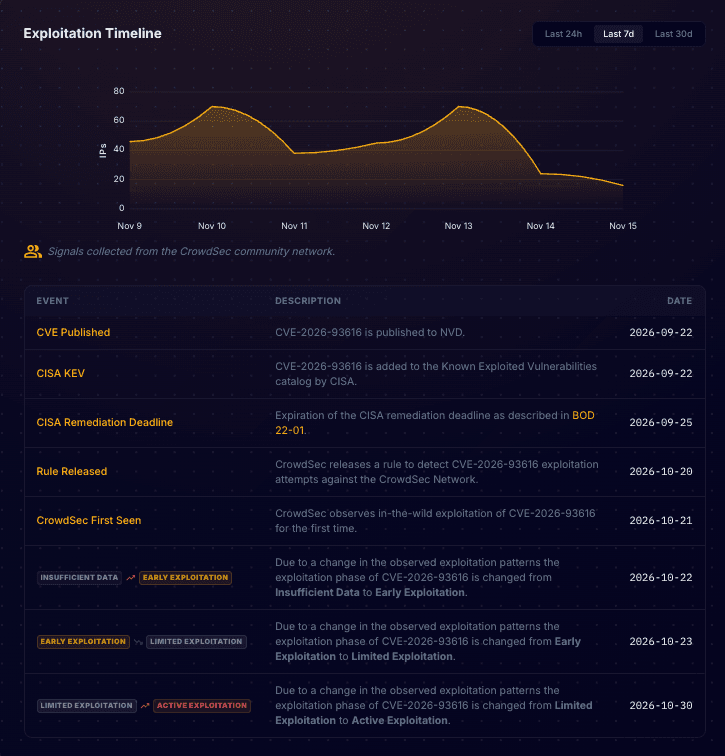
| CrowdSec detection rule live since | October 20, 2026 (the tracker’s “Rule Released” date) |
| First exploitation attempt observed | July 23, 2026, by Check Point Research. October 21, 2026, on the Live Exploit Tracker. |
| Exploitation phase | Active Exploitation (Live Exploit Tracker, since October 30, 2026) |
| Observation window used here | Tagged signals from October 21 to November 15, 2026 (26 days); tracker addresses to November 16; CTI data over the 30 days to November 16. |
Key findings
- Attacked for two months with no fix available: Check Point Research observed “a handful of pinpointed attacks” on July 23, 2026. The fix, the advisory, and the CISA KEV listing came on September 22, 61 days later. Patching stops new attacks. It does not tell you whether your server was hit over the summer.
- One port, no password, full control: Bishop Fox showed the whole attack runs over TCP 19009, which listens on all network interfaces by default, and ends with commands running as root.
- What CrowdSec sees is a fleet checking who is still unpatched, on office hours: 1,839 signals between October 21 and November 15, 956 unique IP addresses on the tracker through November 16. 770 of the 902 addresses in CTI are Amazon servers in Ireland, and signals from Ireland drop from about 55 a day on weekdays to 4 to 8 on Sundays.
What is Check Point Security Management, and who is exposed to CVE-2026-93616?
The Security Management Server is where administrators write the firewall, VPN, and threat-prevention rules for their Check Point gateways and push them out. Large companies and managed security providers use the Multi-Domain version to run many networks, sometimes many customers, from one system. Network and security teams run it, usually inside the network rather than on its edge.
Every management server on an unfixed release is affected. The most exposed answer on TCP 19009 from the internet or a partner network: the service listens on all interfaces by default, so only a firewall rule keeps it private.
Why CVE-2026-93616 matters: The management server decides what every connected Check Point firewall allows. Root on it reaches that policy, the administrator accounts, and the logs an investigation would rely on. One compromised internal server puts the firewall rules of the whole company in an outsider’s hands.
How does CVE-2026-93616 work?
CVE-2026-93616 sits in a web service the management server runs on TCP 19009 for Check Point’s own tools. Parts of it answer requests without a login and do not properly check where uploaded files are allowed to go. Check Point says this lets an unauthenticated attacker place files on the server and run their own scripts. Bishop Fox, comparing fixed and unfixed builds, confirmed the result on lab servers: full control as root. The root cause in one sentence: a management service trusted file locations from callers it had never authenticated.
- Found by Check Point Research while investigating attacks in the wild; no outside finder credited. Analysis: Jon Williams and the Threat Enablement & Analysis Team at Bishop Fox, October 1, 2026.
- Vendor advisory: sk1000171 · Announcement: Check Point blog (Lotem Finkelstein, Check Point Research)
The same announcement covered CVE-2026-85102, a pre-authentication flaw in Security Gateway VPN certificate handling, fixed on September 9 and exploited from September 12 against Spark firewalls (sk1000117, Truesec). The Jumbo takes that fix; R82.10 Take 44 and R81.20 Take 166 are the last ones still vulnerable to CVE-2026-93616.
What is the CrowdSec Network observing for CVE-2026-93616?
Between October 21 and November 15, 2026, the CrowdSec Network recorded 1,839 signals from machines reporting requests that match the CVE-2026-93616 exploitation pattern, detected by the CrowdSec rule released on October 20. That averages 71 per day, peaking at 283 from 62 unique IP addresses on Friday, October 23. The Live Exploit Tracker lists 956 unique IP addresses through November 16.
The requests match the check published by Bishop Fox and in the Nuclei template: one request whose answer reveals whether the server is fixed. It uploads nothing. It builds a list of servers still open, and that list is what someone works from next.
The sources are rented cloud. 58% of signals came from Ireland, 22% from the US, 9% from the Netherlands. Of the 902 addresses CTI links to CVE-2026-93616 over the 30 days to November 16, 770 are Amazon in Ireland. They match a median of 41 CVEs each, and only 3 are rated malicious: a broad scanning fleet that added Check Point to its list. 66 of the 902 also match CVE-2024-24919, the Check Point gateway flaw from 2024, and research scanners from watchTowr and Hadrian appear too. Targets follow where CrowdSec is deployed, led by France (37%) and Germany (19%).
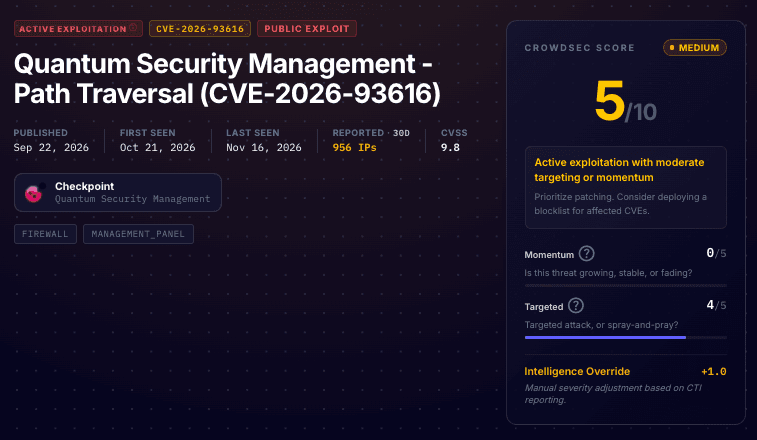
Two things stand out. The first is a burst on Friday and Saturday, October 23 and 24: 459 signals, a quarter of the window, 367 of them from US addresses and 360 rated malicious. On October 24, just 20 addresses reached 111 machines. Outside those two days, the network saw a steady 58 signals a day.
The second is the calendar. In Week 45, Irish signals on Cisco ISE fell sharply on a Saturday, and we couldn’t yet tell whether interest was fading. Four weekends of CVE-2026-93616 data answer it: Irish signals average 55 a day on weekdays, 13 to 17 on Saturdays and 4 to 8 on Sundays. The fleet runs on a weekday schedule. Volume was flat: 443 signals from November 2 to 8 and 431 from November 9 to 15. A quiet Sunday does not mean your server is off the list.
How do you protect Check Point Security Management against CVE-2026-93616?
Patch. Install the fix for your release from sk1000171: the R82.20 Security Hotfix or Jumbo Take 10, R82.10 Take 45, R82 Take 127, R81.20 Take 170 or R81.10 Take 192, or later. LivePatch Take 28/29 does not cover it. Confirm from outside with the Bishop Fox check, which reports “PATCHED” or “VULNERABLE” from one harmless request. R80.x and R81 have no fix: plan the upgrade.
Preemptive blocking. Subscribe to the CrowdSec Intelligence Blocklists. Check Point gateways can load them directly as a Custom Intelligence (IoC) Feed. 208 of the 902 addresses CTI links to CVE-2026-93616 (23%) are on at least one CrowdSec blocklist. That trims the mapping. It does not stop rotating cloud addresses or a targeted attacker the network has never seen.
Stay proactive. Follow CVE-2026-93616 on the Live Exploit Tracker and query its sources in CrowdSec CTI.
Related CrowdSec threat alerts
- Week 45 — CVE-2026-76460, Cisco ISE authentication bypass
- Week 27 — CVE-2026-39808, Fortinet FortiSandbox command injection
- Week 20 — CVE-2025-20362, Cisco ASA VPN authentication bypass
Written by Matthieu M., Data Team Lead, CrowdSec. Published November 16, 2026.