
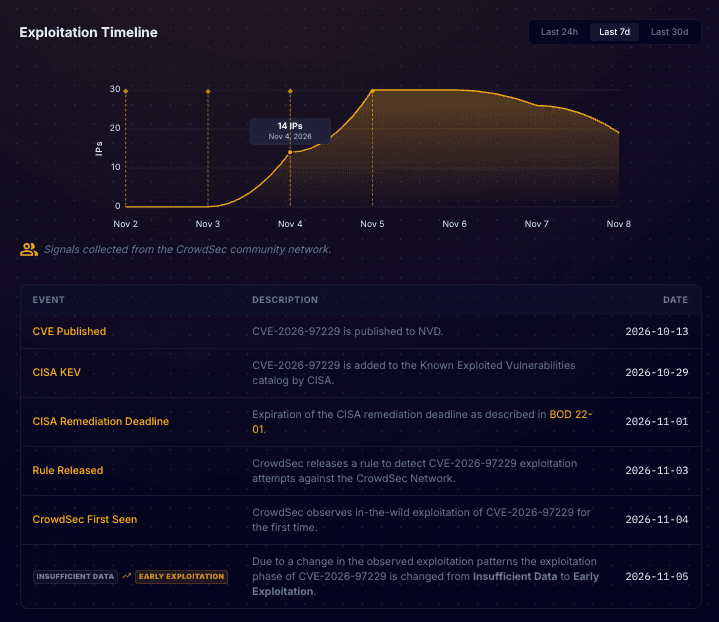
CVE-2026-97229 is a CVSS 10.0 flaw that lets an outsider run their own code on self-managed GitLab servers running versions 19.2 to 19.4. Servers that let anyone create an account are the easiest targets. CrowdSec has observed 102 unique IP addresses sending matching requests since November 4. CISA added it to its Known Exploited Vulnerabilities catalog on October 29. Upgrade to 19.4.2, 19.3.5, 19.2.8, or later, and if GitLab runs on a Ruby you installed yourself, update Ruby too.
Track CVE-2026-97229 live: see how many IPs exploit it right now and block them while you patch.
CVE-2026-97229 at a glance
| Affected | Self-managed GitLab CE/EE 19.2 before 19.2.8, 19.3 before 19.3.5, and 19.4 before 19.4.2. GitLab.com and GitLab Dedicated are already patched. |
| Fixed in | 19.4.2, 19.3.5 and 19.2.8 (GitLab advisory, October 12, 2026). Installations running on their own Ruby also need Ruby 3.3.13, 3.4.12 or 4.0.9 (Ruby advisory, October 23, 2026). |
| Vulnerability class | Integer overflow in Onigmo, the regular expression engine inside Ruby, reached through a GitLab CI/CD configuration (CWE-190) |
| Severity | CVSS 3.1: 10.0 Critical (GitLab) |
| Authentication required | None for the request that triggers it. The public exploit also needs a pipeline file in a public project, which any self-registered account can create where sign-up is open (Rapid7). |
| Public exploit | Yes. Rapid7’s proof of concept, published October 13, runs commands on GitLab 19.4.1 (technical analysis). A Nuclei detection template followed on November 3 (#17657). |
| CISA KEV | Added October 29, 2026, with a November 1 deadline for US federal agencies and forensic triage required |
| CrowdSec detection rule live since | November 3, 2026 (the “Rule Released” date on the tracker). AppSec virtual patch crowdsecurity/vpatch-CVE-2026-97229 on the Hub since November 4. |
| First exploitation attempt observed | November 4, 2026, on the Live Exploit Tracker. Alpine Linux reported attempts against its own GitLab on October 20 and 21. |
| Exploitation phase | Early Exploitation (Live Exploit Tracker, moved up from Insufficient Data on November 5, 2026) |
| Observation window used here | Tagged signals from November 4 to November 8, 2026 (5 days); tracker addresses through November 9; CTI data over the 30 days to November 9. |
Key findings
- A working exploit one day after the patch: GitLab shipped fixes on October 12. Rapid7 reproduced code execution and published a proof of concept on October 13. On October 20, a newly registered account started sending crafted pipeline files to Alpine Linux’s GitLab.
- Upgrading GitLab alone did not close it at Alpine Linux: Alpine moved to GitLab 19.3.6 on October 22 and was still exposed. “Upgrading GitLab is not enough: you also need Ruby 3.3.13, 3.4.12, 4.0.9 or later,” its team wrote.
- Steady, early volume from broad scanning fleets: 225 signals between November 4 and 8, peaking at 69 from 30 unique IP addresses on November 5, and 102 addresses on the tracker through November 9. In CTI, these addresses match a median of 129 CVEs each.
What is GitLab, and who is exposed to CVE-2026-97229?
GitLab is where many companies keep their source code, run the pipelines that build and ship their software, and store the credentials those pipelines need. Engineering and platform teams run it, often internet-facing so remote staff and contractors can reach it. Every self-managed server on an unfixed 19.2, 19.3, or 19.4 release is affected. The ones at most risk let visitors register an account and create projects.
Why CVE-2026-97229 matters: Rapid7’s proof of concept runs commands as git, the account GitLab runs under. That account reaches the repositories and the secrets GitLab keeps for its pipelines, such as cloud keys and deploy tokens. A compromised GitLab server is one step away from the rest of your infrastructure: with the deploy keys and secrets its pipelines use, an attacker can log into the production servers and cloud accounts those pipelines deploy to.
How does CVE-2026-97229 work?
GitLab pipeline files can contain regular expressions, patterns that match text such as file names. GitLab checks the pattern, then Onigmo, Ruby’s regular expression engine, recompiles it for another text encoding after those checks are done. A crafted repeat count overflows the engine’s size calculation, and a carefully built pattern turns that into code execution. Delivery goes through GitLab’s CI lint API, which validates pipeline files: on a public project, Rapid7’s request carries “no token, cookie, or authorization header.” The root cause in one sentence: GitLab validated an attacker’s pattern, then handed it to an engine that rebuilt it with arithmetic that could overflow.
- Reported by Johan Carlsson (joaxcar) through GitLab’s HackerOne bug bounty program. Analysis and proof of concept: Rapid7, with a technical deep dive on October 16.
- Vendor advisory: GitLab Patch Release 19.4.2, 19.3.5, 19.2.8 · Fix: Ruby pull request #19020, shipped in Ruby 3.3.13, 3.4.12 and 4.0.9
Ruby’s advisory ties four GitLab CVEs to the same engine, fixed between GitLab 19.4.1 and 19.5.1: CVE-2026-89078, CVE-2026-93577, CVE-2026-97229, and CVE-2026-110264. Aim for the latest patch release, not the minimum that fixes this one.
What is the CrowdSec Network observing for CVE-2026-97229?
Between November 4 and November 8, 2026, the CrowdSec Network recorded 225 signals from machines reporting requests that match the CVE-2026-97229 exploitation pattern, detected by the CrowdSec rule released on November 3. That averages 45 per day, peaking at 69 from 30 unique IP addresses on November 5. The Live Exploit Tracker lists 102 unique IP addresses through November 9.
By day: 27 on Wednesday the 4th, then 69, 48, 49, and 32 through Sunday. The weekend barely slowed it. The tracker moved CVE-2026-97229 to Early Exploitation on November 5.
The requests come in two steps: a visit to /users/sign_in, then a pipeline file carrying the crafted pattern sent to /api/v4/ci/lint. That is the sequence in the public Nuclei check merged on November 3: confirm the server runs GitLab and read its version, then test whether the lint API accepts the pattern. It sorts patched servers from unpatched ones, and that list is what an attacker works from next.
Sources are rented cloud. Of the 96 addresses CTI links to CVE-2026-97229 over the 30 days to November 9, 33 are Amazon (14 in Ireland, 11 in the US). They match a median of 129 CVEs each, and none matched CVE-2026-97229 alone: broad scanning fleets that added GitLab to their list, alongside research scanners from watchTowr, CERT Polska and Recorded Future. Targets follow where CrowdSec is deployed, led by Germany (20%), France (19%) and the UK (15%).
The part worth flagging is Germany. On Friday, November 6, 23 of the 48 signals came from German addresses and 21 hit machines in Germany. 12 of the 96 addresses sit on CrowdSec’s “Targeted Country: Germany” blocklist, and the tracker notes that some sources check which port or service is running before sending anything. Most of this activity is opportunistic, but not all of it.
How do you protect GitLab against CVE-2026-97229?
Patch. Upgrade GitLab to 19.4.2, 19.3.5, 19.2.8, or later (advisory), preferably the latest patch release on your branch. Rapid7 confirmed its exploit no longer runs on the official 19.4.2 image. Until you can upgrade, turning off open sign-up and stopping untrusted users from creating public projects narrows exposure, per Rapid7. It does not fix the flaw.
Virtual patching with CrowdSec AppSec. The CrowdSec AppSec Component inspects HTTP requests before they reach GitLab and blocks those matching crowdsecurity/vpatch-CVE-2026-97229.
Preemptive blocking. Subscribe to the CrowdSec Intelligence Blocklists and enforce them in front of GitLab. 46 of the 96 addresses CTI links to CVE-2026-97229 (48%) are on at least one CrowdSec blocklist. That trims the scanning. It does not stop an address the network has never seen, or an attacker using an account they registered on your own server.
Stay proactive. Follow CVE-2026-97229 on the Live Exploit Tracker and query its sources in CrowdSec CTI.
Frequently asked questions about CVE-2026-97229
Is CVE-2026-97229 being exploited in the wild? Yes. CISA added it to KEV on October 29, 2026, and Alpine Linux reported attempts on October 20 and 21. The CrowdSec Network recorded 225 matching signals between November 4 and 8, and the Live Exploit Tracker lists 102 unique IP addresses through November 9. CrowdSec cannot confirm any success.
Is upgrading GitLab enough to fix CVE-2026-97229? On GitLab’s official packages and container images, yes: Rapid7 confirmed the 19.4.2 image is fixed. If GitLab runs on a Ruby you install yourself, you also need Ruby 3.3.13, 3.4.12 or 4.0.9. Alpine Linux upgraded GitLab on October 22 and found it had not closed the hole.
Does CrowdSec block CVE-2026-97229 exploitation attempts? Yes, in two ways. The free virtual patch crowdsecurity/vpatch-CVE-2026-97229, run by the CrowdSec AppSec Component, blocks requests that match the exploit before they reach GitLab. And 48% of the addresses linked to this CVE are already on at least one CrowdSec blocklist. Neither replaces the upgrade.
Related CrowdSec threat alerts
It’s the second GitLab flaw we’ve seen exploited in five weeks, after the unauthenticated file read CVE-2026-85706.
- Week 41 — CVE-2026-85706, GitLab unauthenticated file read.
- Week 45 — CVE-2026-76460, Cisco ISE authentication bypass
Written by Matthieu M., Data Team Lead, CrowdSec. Published November 9, 2026.