Protect your content and your products
Stop bots from copying your content, scraping your prices, or buying up stock to resell. Less abusive traffic means less strain on your servers and more resources to serve your customers.
Your website is for visitors, not bots scraping your content. CrowdSec Bot Detection helps you block those bots without getting in the way of your users or verified search engine crawlers. It all runs on your own servers.
 CrowdSec Open-Source WAF: How Bot Detection Really Works
The Problem
Bot detection helps you differentiate human visitors from automated programs accessing your website. Not all bots are harmful: some help search engines find your content. Telling them apart helps you decide which ones to let in and which ones to block.
The challenge is that many bots can pass for ordinary visitors. They use Chrome, connect through residential IP addresses, and send requests that look legitimate. If they spread their activity across different IPs, they can slip under the radar. That’s why traditional IP reputation or rate-limiting approaches won’t stop them.
Stop bots from copying your content, scraping your prices, or buying up stock to resell. Less abusive traffic means less strain on your servers and more resources to serve your customers.
Your visitors are here to browse or buy, not to select images or decipher letters. The check runs in the background. Verified search engine crawlers are exempted.
The proof-of-work challenge requires clients to spend computing resources to access protected pages. For bots solving it at scale, that effort adds up and increases the cost of their activity. Verified bots and excluded routes are exempt.
The Solution
How it works
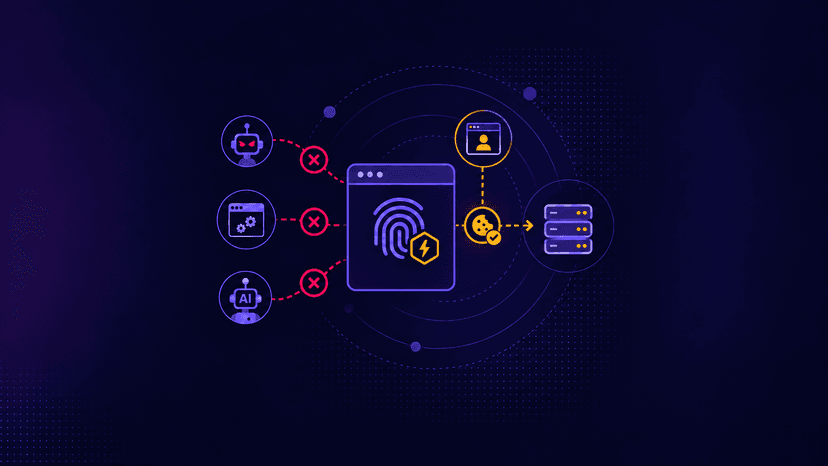
On a first visit to a protected page, the browser completes a small proof-of-work challenge and submits a device fingerprint for analysis. If the browser passes, it receives a cookie that lets the visitor continue browsing. If it fails, access is denied.
What it catches
Browsers controlled through Selenium, Playwright, or the Chrome DevTools Protocol show signs of automation. Some bots try to erase those signs using stealth techniques: CrowdSec catches those thanks to advanced checks and signals that detect small inconsistencies that slip through the attempts to hide the bot’s true identity. Clients that don’t run JavaScript cannot pass the check either.
Distributed botnets
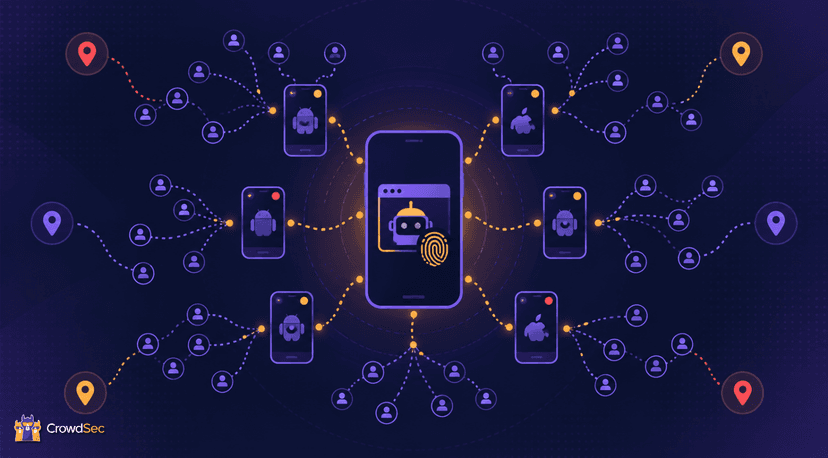
CrowdSec analyzes device fingerprints. This helps it recognize the same device profile across different IP addresses and detect activity that request counts alone might miss.
Good bots
CrowdSec verifies search engine crawlers and uptime monitoring services using their provider’s IP ranges or reverse DNS. Once verified, they can bypass the browser challenge.
AI crawlers
You can allow verified crawlers such as GPTBot, or use the AI Crawlers Blocklist to block listed crawlers at your firewall.
APIs and integrations
Common API routes, webhooks, feeds, and static files are excluded from the challenge by default. You can adjust these exceptions or add others to suit your applications.
Tuning
Use the default configuration, or make it stricter or more permissive to suit your website. When access is denied, you can see which signals contributed to the score and why the check failed.
The rules are open source: you can review each signal’s weight, change it, and add your own signals. You also choose where to run the check, across the whole website or only at key points such as login, signup, or checkout.
Repeat offenders
When an IP repeatedly fails the check or floods the challenge endpoint with requests, CrowdSec can detect that behavior and issue a blocking decision. The remediation component enforces it on your web server or proxy.
Where It Runs
With CrowdSec Bot Detection, you can detect bots without routing your website traffic through an external provider. The CrowdSec Security Engine analyzes browser fingerprints within your infrastructure to decide whether to allow access.
Some cloud-based solutions require traffic to pass through their proxy or CDN, or ask you to send them request data. With CrowdSec, you stay in control of the analysis and the access rules.
through CrowdSec remediation components · Check compatibility
If you share signals with the CrowdSec network, you send attack metadata such as the detection scenario triggered, the time, and the IP address. Your logs and the contents of requests stay within your infrastructure.
The CrowdSec Security Engine receives blocklists built from attacks detected by the CrowdSec community. Your server can then stop listed IPs before they reach the bot challenge. Bot Detection checks the remaining traffic.
Customer Story · MindMax
MindMax runs websites that are free for the public to use in Finland, with a team of just four people. In September 2026, its online dictionaries faced a scraping attack from hundreds of thousands of residential IP addresses. Each IP sent a single request, using browser-like headers and varying User-Agent values that made the traffic look like ordinary visits.
MindMax deployed CrowdSec Bot Detection with the OpenResty remediation component to check requests before they reached PHP.
Read the full case studySource: MindMax case study.
How It Fits
Bot Detection is built into the AppSec component of CrowdSec’s WAF. Here’s how the components work together:
Step 1
Brings protection to your web server. Sends requests that need inspection to AppSec and enforces blocks on your web server or proxy.
Apache · Nginx · OpenResty · HAProxy · Traefik · EnvoyStep 2
Checks requests and detects bots. Applies WAF rules and the bot challenge to decide whether to allow access.
Part of the Security EngineStep 3
Detects abuse and issues blocking decisions. Analyzes detected behavior and generates blocking decisions for remediation components to enforce.
Free and open source (MIT)Step 4
Brings your alerts together. Lets you see what your engines detect, including Bot Detection results, without checking each engine separately.
FreeGet Started
Set up your environment and start detecting bots on your own servers.
A free account lets you view your engines and their alerts in one place.
Create my free accountYou can install it on Linux, Windows, BSD, or in containers.
See how to install itChoose the remediation component that works with your environment. It handles blocking on your server or proxy.
Find the right componentConfigure AppSec and install the bot detection collection with this command:
$ sudo cscli collections install crowdsecurity/The guide walks you through the rest of the setup, including requirements and compatible versions.
The Security Stack
Application Security
The CrowdSec WAF inspects requests for malicious content and attack patterns.
Explore Application SecurityBot Detection
Detect scrapers and automated browsers.
CrowdSec Blocklists
Block IP addresses included in your chosen lists at the firewall.
Explore CrowdSec BlocklistsFAQ
Is CrowdSec Bot Detection free?
Can it stop bots that use residential proxies?
If I enable CrowdSec Bot Detection, will Google and other search engines still be able to crawl my website?
If I block AI crawlers, will assistants cite my content less often?