Vulnerability management has a timing problem.
A CVE can be published in the morning and weaponized by lunch. Meanwhile, your backlog grows, your teams argue over prioritization, and critical starts to mean everything.
Live Exploit Trackeris built for that moment.
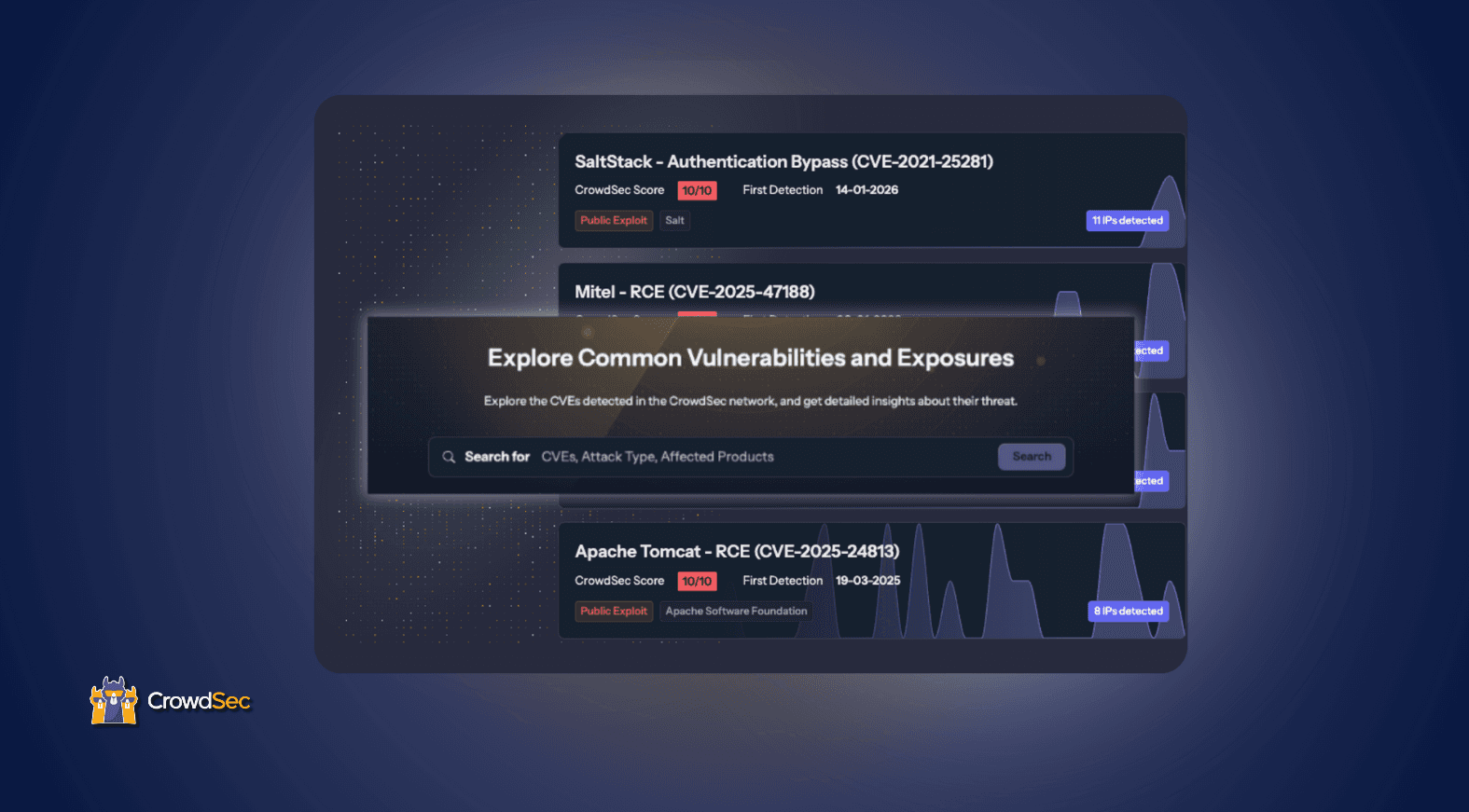
Live Exploit Tracker shows which vulnerabilities are being actively exploited in the wild, the IPs behind the exploitation, and the indicators of compromise (IoCs) associated with real-world attack attempts, based on live activity observed across hundreds of thousands of production systems worldwide.
This is not another list to monitor. It is a way to make faster, calmer decisions.
Live Exploit Tracker helps you prioritize the right CVEs, respond faster when exploitation spikes, and immediately operationalize defenses using IP feeds and IoCs.
What teams get out of Live Exploit Tracker
1. Clear prioritization when everything looks urgent
Live Exploit Tracker provides intelligence built from observed exploitation signals, including profile (opportunistic vs targeted), scale, timeline, and intensity, as well as top targeted countries.
In practice, this helps you answer:
- Is this CVE being exploited right now?
- Is it growing or fading?
- Is it a short spike or a sustained campaign?
So your patching plan becomes evidence-based rather than headline-based.
2. Faster mitigation when patching is not immediate
For each CVE, Live Exploit Tracker provides visibility with IoCs such as IPs and more, sourced from live exploitation attempts.
You can use it as:
- A helper for higher-confidence detection rules with IoCs
- A raw threat intel feed to enrich your SOAR or SIEM
- An edge-consumable blocklist format for common enforcement points like your firewall, CDN, and more
This is the practical win: you can cut exposure quickly while patching and speed up triage during incident response.
3. Earlier warning on what attackers are lining up next
Live Exploit Tracker also includes Pre-CVE Scouting. It shows IPs probing a vendor or technology over roughly the last 36 hours, including campaigns hunting for unknown vulnerabilities.
If you run internet-exposed infrastructure, this gives you a head start to harden and monitor before the disclosure catches up.
Why Live Exploit Tracker signals are operational, not noisy
Live Exploit Tracker is fueled by production telemetry. That matters because production systems are real targets: VPN gateways, APIs, login pages, business apps. This is where attackers try to win.
Production telemetry also surfaces higher-quality indicators. Attackers reveal more when they think they are on a real system and not a decoy.
You can enforce Live Exploit Tracker signals because they reflect the real state of exploitation, not algorithm-based extrapolations.
How Live Exploit Tracker fits your workflow
Live Exploit Tracker is designed to be actionable. Query exploitation intelligence via an API and feed your existing tools to enrich alerts and trigger playbooks. Drive mitigations based on what’s currently being exploited.
- Enrich your vulnerability backlog with an active exploitation context so the top of your priority list reflects reality, not just severity
- Flag changes in trend. When exploitation spikes, Live Exploit Tracker helps you spot it early and re-rank work without waiting for downstream advisories
- Create a “Patch Now” view for internet-facing assets and critical services, with clear justification for stakeholders
To wrap it up
CVE, CVSS, EPSS, and KEV still matter. They give structure.
Live Exploit Tracker adds the missing piece: what attackers are actually doing, plus the IPs and IoCs that let defenders respond quickly and confidently.