Honeypots vs Production Telemetry: What CISOs Should Trust for Threat Intelligence
Threat intelligence sounds simple on paper. Collect signals. Spot bad actors. Block them fast. In practice, it gets messy. Most feeds raise more questions than they answer, and when they cannot be used to take action, they’re simply noise.
A big part of the problem is this: not all threat intelligence is collected the same way. Two familiar sources are honeypots and production telemetry. They can both be useful. But they do not tell you the same story.
Honeypots are great at one thing: internet weather
A honeypot is a decoy. It is meant to be found and tested. That makes it good at capturing the constant noise of the internet.
Using honeypots, you will see scans, lots of them. You will see commodity bots. You will see known CVE opportunistic exploitation attempts. This helps you understand what is trending.
If your goal is visibility into broad activity, honeypots deliver.
But there is a catch.
Honeypots can be identified and dodged
Many honeypots live on ranges that look like “lab infrastructure.” Datacenter IPs, consistent patterns, similar stacks, similar behaviors. Over time, attackers learn what these systems look like.
Even low to mid-level tooling can do basic fingerprinting. Some attackers keep lists. Others simply deprioritize anything that smells like a trap. In any case, when attackers possess valuable exploits, they use them on their targets and not indiscriminately on unknown IPs.
That creates bias. Using honeypots, you mainly observe what attackers are willing to touch blindly. You do not reliably observe what they do when money is on the line.
Another key aspect of Honeypots is that automation is essential for scaling them. Your go-to infrastructure will likely be with major cloud providers, allowing you to automate the deployment of your containers (or VMs). In this case, the distribution and variety of your honeypot network are limited to some well-known ranges of IP addresses. For the very same reason, this limits CDNs’ ability to catch threats ahead of the curve (who would use a new technique or 0-day on an exceedingly careful target?), sitting on a bunch of known ranges gives you an incomplete picture of the real world.
Production telemetry captures intent because it sits on real targets
Production workloads are the opposite of decoys. They are the objective: login pages, VPN gateways, APIs, mail servers, business apps. This is where attackers try to win.
That is why telemetry from production environments is so valuable. It captures behavior aimed at real outcomes: account takeover, fraud, API abuse, layer 7 denial-of-service, and targeted exploitation of stacks that actually run revenue.
Production telemetry is where you reliably capture valuable Indicators of Compromise (IoCs), because attackers must engage with a real service. You see real patterns, like targeted URLs, exploitation payloads, and credentials. That precious information is disclosed only when attackers know they have reached a valuable target and not wasted in a honeypot environment.
This is the core difference for a CISO: honeypots show you what exists on the internet. Production telemetry shows you what is being used against real businesses.
What “production telemetry” means with CrowdSec, in plain terms
CrowdSec’s approach is to detect malicious behavior in logs and web traffic in real time on internet-exposed workloads. The Security Engine reads, normalizes, and enriches logs from many sources, including cloud services and standard log pipelines.
Detection is contextual. It does not treat every system the same. With a VPN, it detects brute-force and credential-stuffing attempts. An e-commerce site can detect catalog theft, scalping, credit card stuffing, and Layer 7 DDoS attacks.
This is why the CrowdSec signal tends to be more “honest.” Attackers have to interact with something tangible.
Context matters more than volume
Most feeds compete on quantity. More IPs. More alerts. More “Top Attackers.”
CISOs would rather have clearer decisions and actionable insights.
The strongest signals come from context. What was attacked? How? How often? On which type of service? Whom by? Was it a new IP, a known one? Did it attempt to knock my servers using other techniques before? Was it a brute force attempt? Was it credential stuffing or injections? Was it scanning that led to exploitation? Are authentications coming from those IP addresses known to be impossible travelers?
This is where production-based detection wins. It is tied to real logs and real services. That context is what turns observations into enforceable policies, while reducing false positives to zero.
The SOC angle: richer alerts, less guesswork
SOC teams care about the “why,” not just the “what.” CrowdSec can enrich alerts with details such as username attempts, targeted URLs, scanned ports, verticals, or countries.
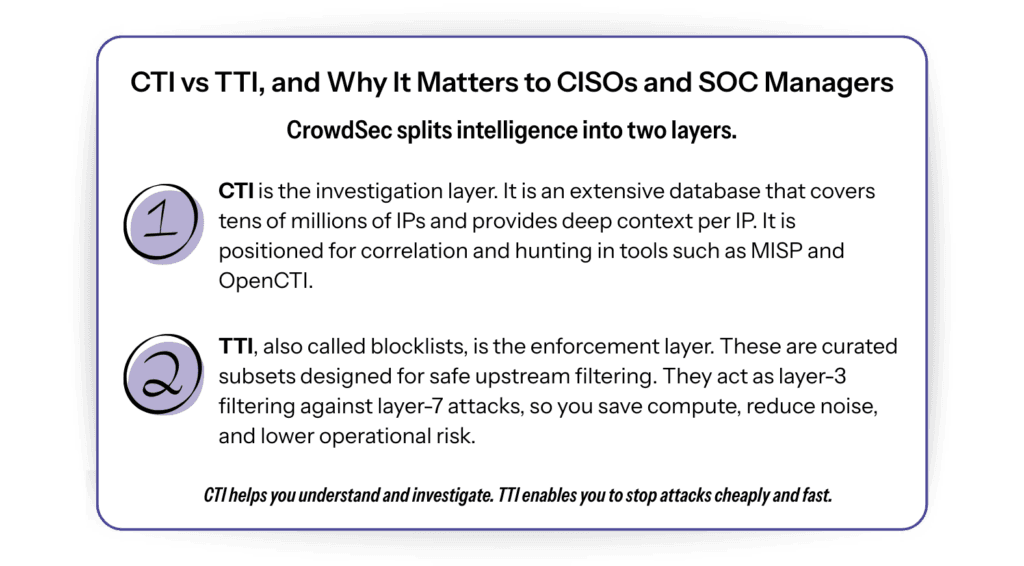
It also positions itself as a companion to the SIEM, and an actionable “pre-filter.” The idea is simple: triage in-stream, suppress noise, and avoid paying to store and investigate junk at scale.
Honeypots still have a role
Honeypots are not useless. They are just not sufficient on their own.
They are suitable for early warning and trend spotting. They are good for research. They help you understand the background threat landscape.
But if your goal is prevention at scale, you want intelligence that reflects real attacks against real targets. That is what production telemetry gives you. And that is the foundation CrowdSec uses. CrowdSec explicitly positions itself as different from a honeypot network for this reason: it protects real workloads from real customers that attackers actually want to monetize.
Closing thought
Honeypots tell you who is knocking on doors.
Production telemetry tells you who is trying to get in, where they are pushing hardest, and what they are trying to achieve, their “Why”.
For CISOs, that is the difference between interesting threat intel and tactical threat intel you can turn into enforcement.