Cybersecurity failures rarely come from a lack of effort. More often, they come from assumptions that seem reasonable but are wrong. Many organizations think they’re too small to be targeted, that low-severity vulnerabilities can wait, or that buying more tools makes them safer. Others rely on scores, checklists, or the idea that “good intentions” are enough.
Attackers thrive on these misconceptions. They exploit gaps from false confidence, fragmented tools, delayed patching, and decisions made without context. Knowing where these beliefs fail is key to reducing real-world risk.
This article covers five common security myths, why they persist, and what really matters for defending modern environments.
Myth 1: “We’re too small to be a target.”
Dataversity reports that Ransomware-as-a-Service surged by 60% in 2025, dramatically lowering the barrier to entry for cybercriminals. As a result, launching an attack no longer requires advanced skills or significant resources. But who is most at risk? Contrary to common assumptions, it’s not large enterprises. Businesses with fewer than 1,000 employees accounted for 46% of all cyber breaches.
Smaller organizations are frequent targets because they often lack dedicated IT teams, enterprise-grade tools, and up-to-date systems. Limited budgets and a false sense of security lead to weak controls, outdated software, and unpatched vulnerabilities.
Attackers go after the same valuable data as in larger firms: customer info like names, emails, and financial details, as well as internal records that can be monetized or used in follow-on attacks.
The financial impact of these incidents can be devastating. As noted in a TechXplore article by Roxana Popescu, 37% of companies lost more than $500,000 per incident last year. Another quarter lost up to $250,000, while an additional 25% suffered losses between $250,000 and $500,000. To recover, businesses were forced to dip into cash reserves, seek funding from investors, cut jobs, or rely on credit or cyber insurance. And, in 38% of cases, pass the costs on to customers.
These attacks may not always make headlines, but their consequences are very real. Thousands of small businesses quietly struggle, or fail outright, after a cyber incident. One such example is Efficient Escrow of California, which was forced to shut down and lay off its entire staff after cybercriminals siphoned $1.5 million from its bank account using Trojan malware.
✨Takeaway: Small businesses are prime targets not due to low value, but because limited security makes them vulnerable. Accessible attack tools and valuable data mean stronger defenses, and timely patching is essential, regardless of size.
Myth 2: Low-severity vulnerabilities don’t matter
The term low-severity vulnerability often creates a false sense of safety. In security scoring systems, “low severity” typically means that a flaw has limited impact on its own, is difficult to exploit in isolation, or does not immediately expose sensitive data. It does not mean the vulnerability is harmless, irrelevant, or safe to ignore.
Severity ratings are designed to evaluate individual issues in isolation. In the real world, however, attackers don’t operate that way. They look for paths, not single weaknesses. A low-severity issue can provide just enough information or access to help an attacker move closer to their objective (often called a chain).
An example of a low‑severity vulnerability that was highly exploited was Atlassian Jira CVE‑2021‑26086. When CVE‑2021‑26086 was first disclosed, it was classified as a path traversal vulnerability with limited impact. On its own, the issue allowed unauthenticated attackers to read internal files from vulnerable Jira Server and Data Center instances, without enabling direct code execution. Because it was primarily an information disclosure flaw, it was generally considered low to medium severity, not an immediate critical threat.
However, attackers quickly showed how this “minor” issue could still be valuable:
- The path traversal enabled access to internal configuration files and metadata, providing insight into the Jira environment.
- Exposed information helped attackers map deployments, identify software versions, and spot additional weaknesses.
- The vulnerability required no authentication and affected internet‑facing Jira instances, making it easy to automate and scan at scale.
Within a short time, CVE‑2021‑26086 was:
- Widely scanned and exploited across the internet
- Used as a reconnaissance and foothold vulnerability
- Leveraged to support follow‑on attacks when chained with other flaws
✨Takeaway: Low-severity vulnerabilities matter because attackers can chain them into high-impact exploits. Fixing them alongside more serious issues reduces the attack surface and prevents small weaknesses from being leveraged together.
Myth 3: More tools mean fewer vulnerabilities
There’s a common belief that layering more security tools automatically reduces risk. In practice, adding tools without a clear strategy often increases complexity instead of improving security.
Security tools don’t protect systems on their own. Without proper configuration, tools may miss threats or generate excessive noise. Poor integration between tools can create blind spots, and without skilled analysis, important alerts may be ignored or misunderstood, leaving gaps in your defenses.
In many organizations, breaches don’t happen because tools are missing, but because complexity and poor integration leave gaps that attackers can exploit. A recent industry analysis describes how “security tool sprawl” creates blind spots, inconsistent alerting, and fragmented visibility that directly increase security risk. According to the survey, 41% of IT and security teams link poor integrations directly to increased risk, with disconnected tools making it harder to see threats thoroughly or automate responses. Attackers increasingly target these integration seams because fragmented stacks slow detection and response.
When tools don’t share context or correlate alerts across environments, critical signals can be scattered across dashboards, delaying investigation and allowing attackers to operate longer without being noticed. Integrated systems and shared context are what allow security teams to connect the dots; without them, the presence of more tools can increase the attack surface instead of reducing it.
Frameworks like the NIST Cybersecurity Framework (CSF) and the MITRE ATT&CK knowledge base both emphasize process, integration, and human expertise rather than adding more tools. Similarly, ENISA highlights that effective cybersecurity requires a risk-aware, structured approach where tools are used thoughtfully, in context, and integrated into well-defined processes.
What you can do instead:
- Configure security tools carefully and review settings regularly.
- Integrate tools so alerts share context and reduce blind spots and noise.
- Define clear ownership and processes for investigating and responding to alerts.
- Invest in people and training.
✨Takeaway: Security isn’t about the number of tools you deploy. Effective security comes from using the right tools, integrated into clear processes, and backed by human expertise.
Myth 4: Patching is easy if you care about security
Many people believe patching is simple: apply the fix, and you’re protected. In reality, patching can be complicated. Fixes can bring compatibility issues, disrupt applications, or require extensive planning and testing before deployment. Some environments, like healthcare or financial institutions, can’t be patched immediately without careful validation to avoid affecting operational impact.
Even security-conscious organizations sometimes delay patches. Not because they don’t care, but because teams may need time to test patches in staging environments, schedule downtime, and coordinate across dependencies to ensure continuity of service. Rushing a patch without proper preparation can create as many problems as it prevents.
A dramatic example occurred on 19 July 2024, when a routine configuration update for CrowdStrike’s Falcon endpoint security software caused systems worldwide running Microsoft Windows to crash, enter boot loops, or fail to restart properly. Roughly 8.5 million Windows devices were affected as the flawed update triggered blue screens of death and disrupted operations across airlines, hospitals, emergency services, banking systems, and government services. This was not a malicious attack, but a faulty patch that had passed automated validation before deployment, illustrating how even well-intended software updates can cause global outages when not properly tested for real-world environments.
Best practices for effective patching:
- Keep a clear inventory of all assets.
- Prioritize patches based on risk and criticality, not just severity.
- Test patches in staging environments before deploying to production.
- Use vulnerability management tools to identify known vulnerabilities and missing patches across your systems continuously.
- Automate routine patches but keep human oversight for critical systems.
- Maintain regular patch schedule and track compliance.
✨Takeaway: Patching isn’t just about applying fixes. It requires continuous vulnerability management, planning, testing, and balancing security with operational needs.
Myth 5: CVSS scores tell the whole story
The Common Vulnerability Scoring System (CVSS) provides a standardized way to rate vulnerability severity. Many organizations rely on CVSS scores alone to prioritize fixes, which can be misleading. CVSS indicates potential impact in general terms, not the actual risk to your specific environment.
A high CVSS score doesn’t automatically mean a vulnerability is fully understood or that your organization knows exactly where it exists. Context matters; the criticality of affected assets, network exposure, and whether active exploits exist all influence real risk. Ignoring these factors can leave serious gaps, even for vulnerabilities rated as “critical”.
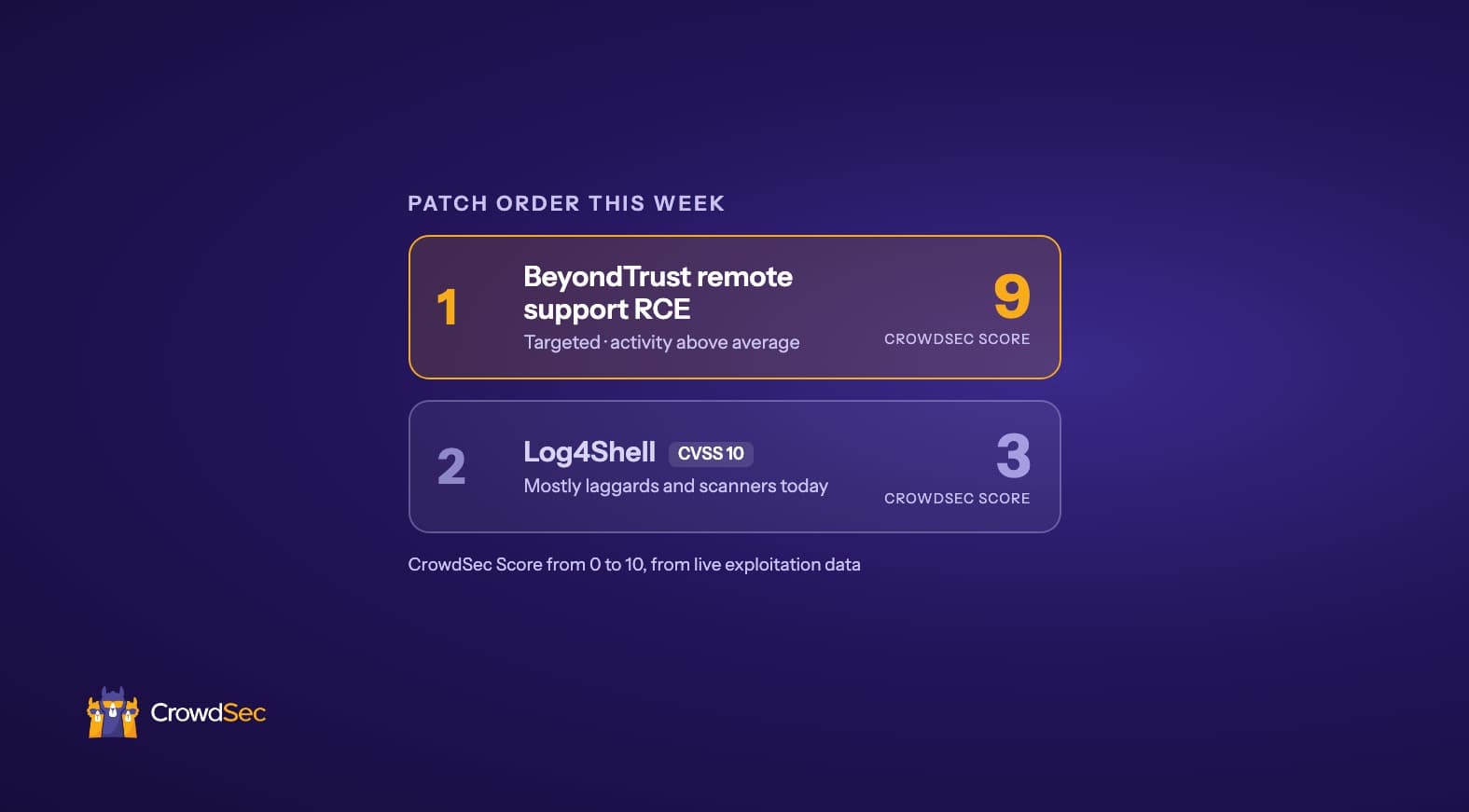
An example is Log4Shell (CVE-2021-44228). It received a CVSS score of 10, the highest possible rating. Despite this, many organizations struggled to identify which systems and applications were affected because Log4j is a library that often exists deep in software dependency chains or embedded in third-party products. Teams without complete visibility or software inventory faced delays in assessing risk, even though the vulnerability itself was theoretically critical. Attackers quickly began exploiting exposed instances, demonstrating that a high CVSS score alone is not enough. Organizations must understand where and how the vulnerability exists in their environment.
What you can do:
- Use CVSS as a starting point, not a decision on its own.
- Evaluate vulnerabilities based on your environment, asset criticality, and threat landscape.
- Use risk-based prioritization to focus remediation efforts.
- Combine CVSS with threat intelligence and visibility into your systems to guide decisions.
✨Takeaway: CVSS scores are helpful, but context is key. Understanding how vulnerabilities exist in your environment and prioritizing based on actual risk is far more important than relying solely on the number.
To sum it up
Cybersecurity fails less from ignorance than from oversimplification. Myths like “small means safe,” “scores tell the whole story,” or “more tools = better protection” create false comfort. Attackers exploit complexity, context gaps, and blind spots.
Reducing risk requires seeing what’s really happening: which vulnerabilities are exploited, how attacks unfold, and where exposure lies. Real-time exploit intelligence helps teams prioritize, respond faster, and stay ahead of emerging threats.