Around security discussions, you’ve probably noticed the words “vulnerability,” “threat,” and “risk” being used more or less interchangeably. They’re not. Mixing them up isn’t just imprecise; it leads to bad prioritization, wasted effort, and the occasional 3 AM incident that could have been avoided.
This article breaks down what each term actually means, how vulnerabilities move through their lifecycle, and what that means for you as a developer or maintainer.
What even is a vulnerability?
At its core, a vulnerability is a weakness in a system that someone could exploit. It doesn’t have to be a dramatic zero-day in a cryptography library. It can be something simply mundane, like a forgotten admin endpoint with default credentials, or a dependency that hasn’t been updated in two years.
Vulnerabilities tend to fall into a few buckets:
- Software bugs: Logic errors, memory issues, improper input handling, the kinds of things that slip through code review and only reveal themselves under the right (wrong) conditions.
- Misconfiguration: Open ports that shouldn’t be open, overly permissive IAM roles, debug endpoints left on in production. Config issues are responsible for a huge proportion of real-world breaches.
- Human factors: Weak passwords, phishing susceptibility, and the developer who commits an API key because they were in a hurry. This category is frustratingly durable.
The key thing to understand: a vulnerability sitting quietly in your codebase isn’t actively hurting anyone. It only becomes a problem when someone finds it and does something with it.
Vulnerability vs. threat vs. risk
These three concepts form a chain, and understanding the chain is what lets you make sensible decisions about where to spend your time.
- Vulnerability is the weakness (an unpatched library, a misconfigured firewall rule).
- A threat is the actor or mechanism that could exploit it (an attacker, an automated scanner sweeping the internet).
- Risk is what you’re actually trying to manage: the likelihood that the threat exploits the vulnerability, multiplied by the impact if it does.
A concrete example: say your app has an admin panel exposed to the internet with default credentials still set. That’s your vulnerability. The threat is anyone running credential-stuffing tools against it, and there are plenty of those running 24/7. The risk is high because both the likelihood and the potential impact (full admin access) are significant.
Contrast that with a theoretical XSS in an internal tool used by two people on your team. Still a vulnerability, much lower risk. This framing is how you avoid treating every CVE as an alarm fire.
The vulnerability lifecycle
Vulnerabilities don’t just appear and disappear. They go through a lifecycle, and where you are in that lifecycle dramatically affects how much danger you’re in.
Discovery
Someone finds the vulnerability: a security researcher, a developer doing a code review, a bug bounty hunter, or an attacker. The discoverer’s intentions shape everything that happens next.
Disclosure
How the vulnerability gets reported matters a lot. There are three main patterns in the wild:
- Responsible disclosure: The researcher contacts the vendor privately and gives them time to fix it before going public.
- Coordinated disclosure: A deadline is set, typically 90 days, after which the details go public regardless of whether a patch exists. This is now the dominant approach, popularized by Google Project Zero and CERT/CC. It puts real pressure on vendors to actually ship fixes rather than quietly hoping nobody notices.
- Full disclosure: Everything goes public immediately. Controversial, but the argument is that it forces faster action and gives defenders the information they need without waiting on vendor timelines.
The exploitation window
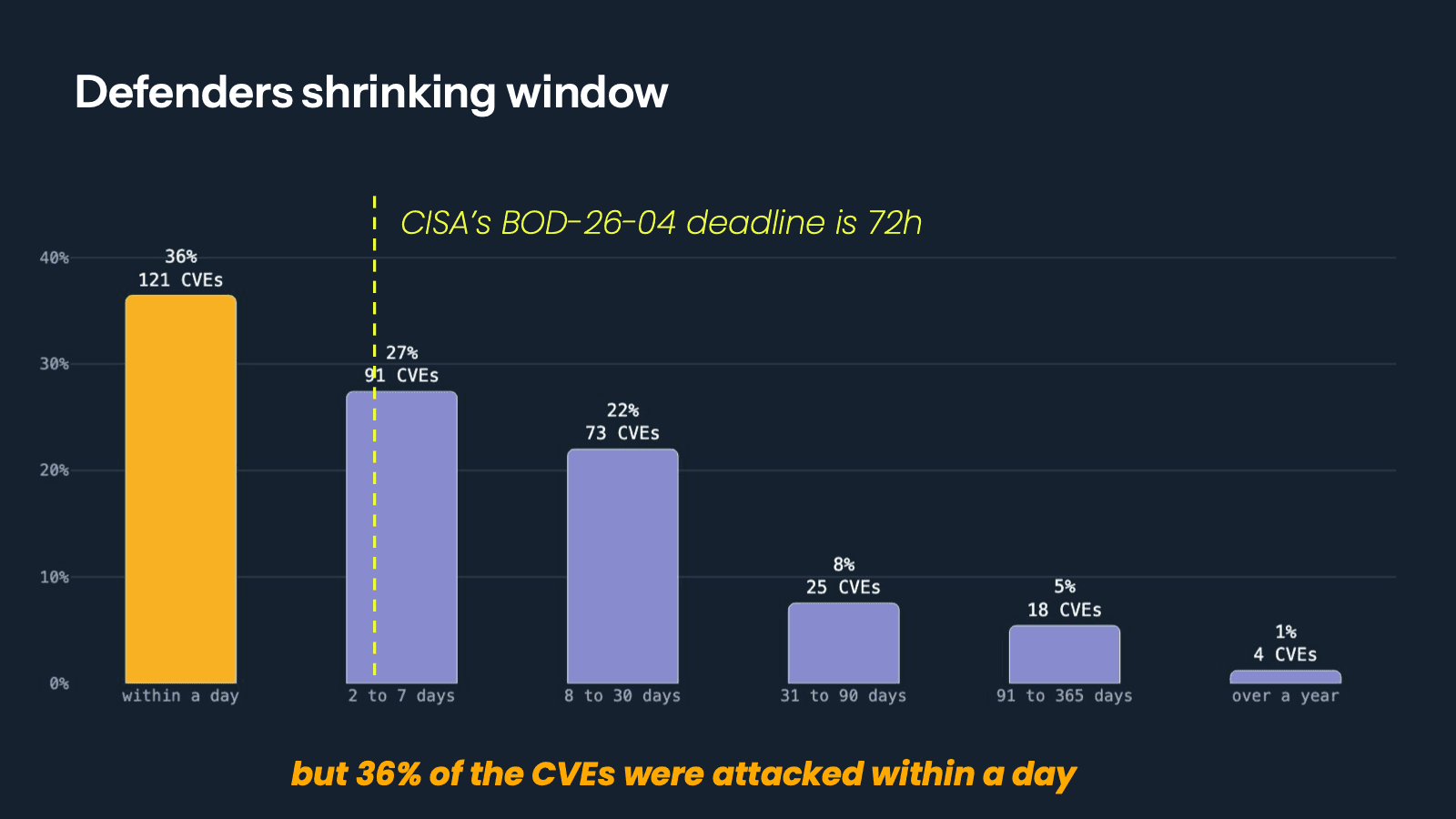
This is where things get uncomfortable. Between when a vulnerability is discovered (or disclosed) and when it’s actually patched across affected systems, there’s a window of exposure. For zero-days, vulnerabilities being actively exploited before any patch exists, that window starts the moment the attacker finds it.
The exploitation window is why patch speed matters so much. It’s not theoretical. Once a CVE drops with a working proof-of-concept attached, mass exploitation often starts within hours.
Patch and remediation
The vendor ships a fix. In the open source world, this usually means a PR gets merged, a new version gets tagged, and a CVE gets assigned with a CVSS score that tells you how severe the issue is considered to be. CVSS isn’t perfect; it doesn’t account for your specific environment, but it’s a useful first filter for prioritization.
Resolution and monitoring
Applying the patch is not the end of the story. You need to verify it’s actually deployed everywhere it needs to be, and keep watching for signs that exploitation happened before you patched. Logs, alerts, anomaly detection, and the operational work that actually catches incidents.
How vulnerabilities get found
In practice, most vulnerabilities surface through one of these channels:
- Security audits and code review: Organizations proactively scan their own systems and codebases for weaknesses.
- Bug bounty programs: External researchers are incentivized to find and responsibly report vulnerabilities.
- Accidental discovery: Users or developers notice unexpected behavior that points to a weakness.
- Malicious discovery: Attackers actively probe systems to find exploitable vulnerabilities.
When a vulnerability becomes an incident
Most vulnerabilities never turn into incidents. The ones that do tend to share a common thread: they were known, there was a fix available, and nobody got around to applying it.
An incident happens when a vulnerability gets actively exploited and causes real harm, data exfiltration, services taken down, and credentials compromised. At that point, you’re no longer in vulnerability management territory; you’re in incident response, which is a different and much more stressful.
Staying on the right side of that line comes down to a few practical habits: patch quickly (especially anything with a high CVSS score or active exploitation reports), monitor for anomalous behavior, and treat your CVE feed as something worth actually reading.
Why does this matter if you’re building or maintaining software
If you’re a developer, the decisions you make, which dependencies you pull in, how you configure your deployment, and whether you have a process for responding to vulnerability disclosures in your own project, have downstream consequences for everyone using your software.
Open source maintainers carry a particular version of this responsibility. When a vulnerability is found in a widely-used package, the blast radius can be enormous. Having a clear disclosure policy, staying reachable, and shipping fixes promptly are part of what makes open source software trustworthy.
Security doesn’t have a finish line. Understanding how vulnerabilities work, how they get discovered, and how they move from disclosure to exploitation is the foundation for making better decisions across the whole chain, from the code you write to the alerts you triage at midnight.