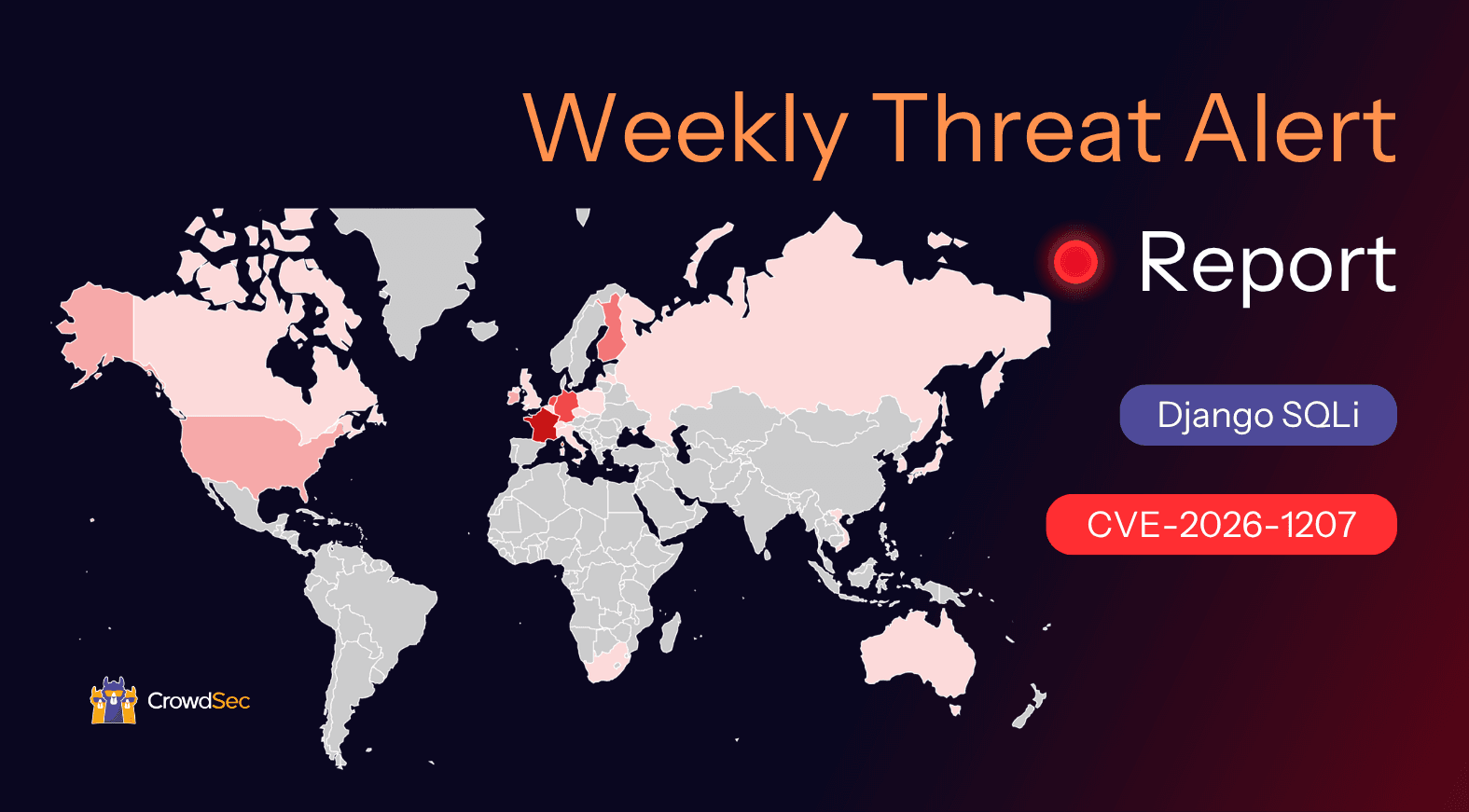
The CrowdSec Network recently added a detection rule for CVE-2026-1207 in the Django Web Framework. The network has now detected a steady stream of exploitation attempts targeting CVE-2026-1207, making CrowdSec the first to confirm that this vulnerability is now exploited in the wild. The vulnerability has not yet been added to the CISA known-exploited-vulnerabilities (KEV) catalog; we expect this to happen soon.

Key findings
- CVE-2026-1207 was published on February 3, 2026. CrowdSec released a detection rule on February 18, 2026. CrowdSec observed the first attacks targeting CVE-2026-1207 on February 26, 2026.
- Observed exploitation volumes remain steady week-over-week, indicating sustained interest from threat actors.
- Most observed attacks involve focused reconnaissance to identify vulnerable Django and PostGIS configurations, suggesting sophisticated targeting rather than broad spraying.
What is Django?
Django is a high-level Python web framework that encourages rapid development and clean, pragmatic design. It is widely used by enterprises, startups, and governments to build robust web applications, from content management systems to complex data-driven platforms. It is one of the oldest web frameworks that is still in use today and was considered the industry standard web framework for many years.
This specific vulnerability impacts Django instances using GeoDjango with the PostGIS backend, a popular choice for geospatial applications. Organizations rely on Django for critical business logic and data handling. A SQL injection vulnerability here means attackers could potentially bypass authentication, access sensitive user data, or modify database contents. The fact that it requires a specific configuration (PostGIS) means the blast radius is somewhat restricted, but for those using it, the risk is critical.
How does CVE-2026-1207 work?
The vulnerability resides in the RasterField lookups within Django’s GIS module when using the PostGIS backend. A flaw in how the band index parameter is handled allows remote attackers to inject malicious SQL commands. Attacks typically target endpoints with parameters like /?band= or /api/raster/search/?band=. The injected payloads attempt to trigger database errors or extract information, effectively bypassing the framework’s built-in protections. Original discovery and technical details are credited to Tarek Nakkouch.
Threat Landscape Analysis

Despite not yet appearing in the CISA KEV catalog, CVE-2026-1207 is active. CrowdSec telemetry shows a clear, non-accidental pattern of exploitation. The attacks are not massive volumetric spikes but consistent probing, which is often a precursor to more damaging, targeted campaigns. Threat actors are actively filtering for vulnerable PostGIS setups, meaning if you are exposed, you are likely already being scanned.
How to protect your systems
Patch Immediately: Upgrade your Django installation to the latest secure versions:
- 6.0 series: Upgrade to 6.0.2 or later.
- 5.2 series: Upgrade to 5.2.11 or later.
- 4.2 series: Upgrade to 4.2.28 or later.
Preemptive Blocking: Deploy CrowdSec WAF in your network to detect and immediately block exploitation attempts.
Stay Proactive: Review your application logs for unexpected database errors or unusual query parameters. Ensure that your Django debug mode is disabled in production to prevent leaking stack traces that could aid attackers.