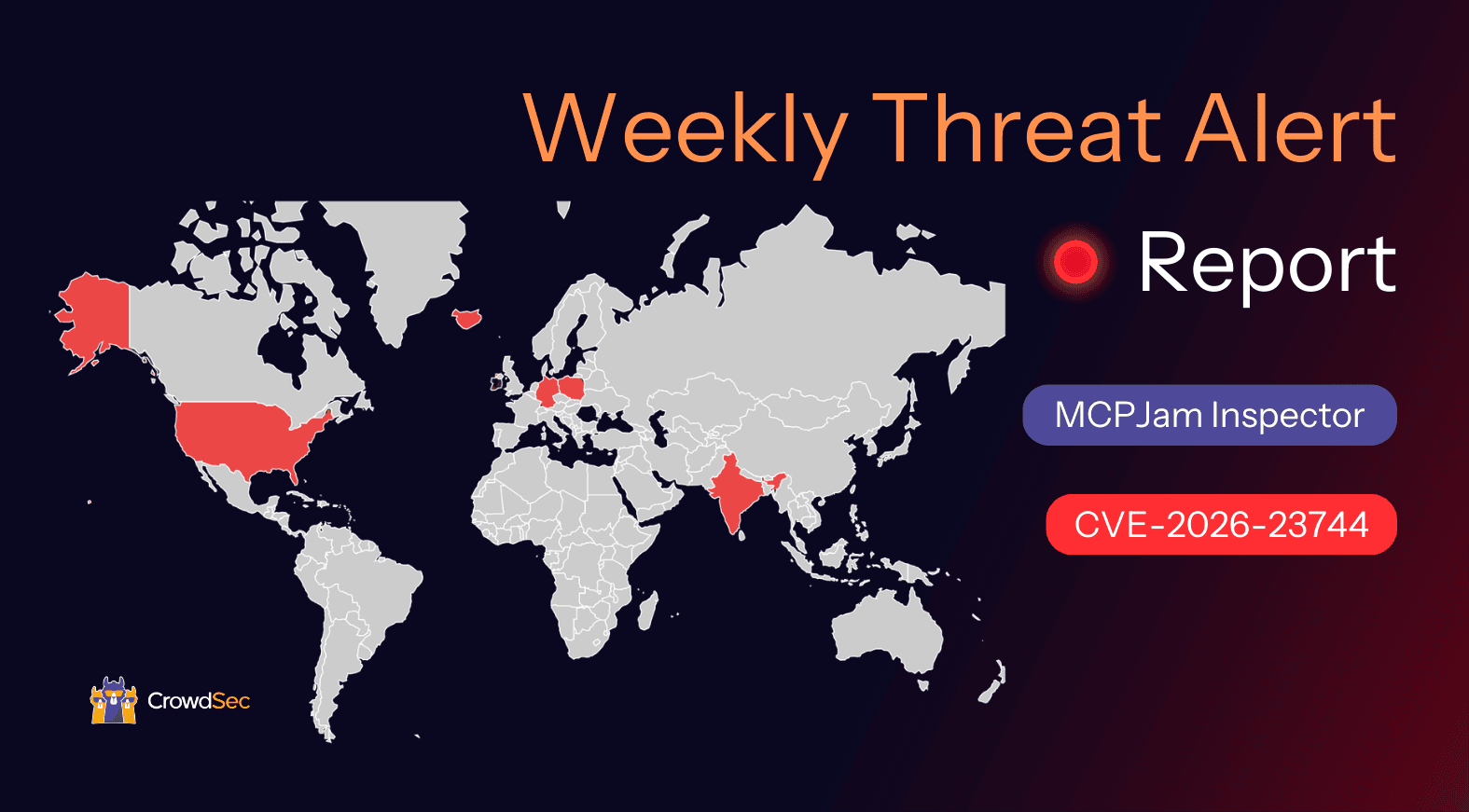
As the number of AI tools developed continues to increase, so does the number of threats and vulnerabilities they introduce. Unfortunately, many of these rapidly developed tools are often built with dubious coding practices and quality assurance, prioritizing speed and ‘getting a feel’ over robust security and thorough testing. This leaves AI developers and homelab tinkerers as the main targets for opportunistic attackers, looking for easy prey. This week is no exception: the CrowdSec Network has detected a surge of exploitation attempts targeting CVE-2026-23744, a critical Remote Code Execution (RCE) vulnerability in MCPJam Inspector.

Key findings
- Release Date: CVE-2026-23744 was published on January 16, 2026. CrowdSec released a detection rule on February 18, 2026.
- Surging Trend: A global pattern targeting AI development tools is emerging, including other more famous networks like OpenClaw (more on this during the next weeks).
- Attack Vector: Attackers are targeting the default configuration of MCPJam Inspector, which listens on
0.0.0.0, allowing remote access to the/api/mcp/connectendpoint and subsequent code execution.
What is MCPJam Inspector?
MCPJam Inspector is a local-first development platform for building and testing Model Context Protocol (MCP) servers. It is a tool for developers, software engineers, and AI tinkerers who are building the next generation of AI-connected applications.
Why it matters: This tool is designed for development environments, meaning it often runs with high privileges and without the robust security controls of production software. When compromised, it gives attackers a direct foothold on developer workstations, arguably the most sensitive part of any organization’s network.
How does CVE-2026-23744 work?
The vulnerability is a classic case of “it works on my machine” gone wrong. MCPJam Inspector, by default, listens on all network interfaces (0.0.0.0) instead of just localhost (127.0.0.1). Combined with a lack of authentication on critical endpoints, this creates a massive security hole.
Attackers can send a crafted HTTP request to the /api/mcp/connect endpoint with a specific JSON payload. By manipulating the command and args fields, they can execute arbitrary commands on the host machine. Essentially, if you can reach the Inspector, you can own the machine.
Security researchers have published proof-of-concept exploits, and the barrier to entry for attackers is extremely low.
Threat Landscape Analysis
CrowdSec has observed exploitation attempts targeting CVE-2026-23744 starting from mid-February 2026. The attacks are not accidental sprays; they show signs of focused reconnaissance, where threat actors are actively scanning for exposed development environments.
This trend highlights a critical risk: development tools are often the soft underbelly of corporate security. The data reports are still sparse to draw a quick conclusion, but attackers will soon realize how many developers have left their doors wide open.
How to protect your systems
This vulnerability is a stark reminder that users can easily shoot themselves in the foot if they don’t know what they are doing. Tinkerers and developers must be extra vigilant and pay attention to the best development practices before rushing to run an experiment.
- Patch: Upgrade to MCPJam Inspector version 1.4.3 or later immediately. The patch restricts the default listening address and adds necessary security controls.
Configuration Best Practices
- Never expose such services on the internet. Ensure MCPJam Inspector is bound to 127.0.0.1 (localhost) only.
- If remote access is necessary, use a secure tunnel (like SSH or a VPN) and ensure strict access controls are in place. Do not rely on the tool’s built-in security for public exposure.
Preemptive blocking
- Finally, install CrowdSec: Deploy CrowdSec WAF at the front door of your network to detect and immediately block exploitation attempts.